
HT Driving School · 2026-09-22
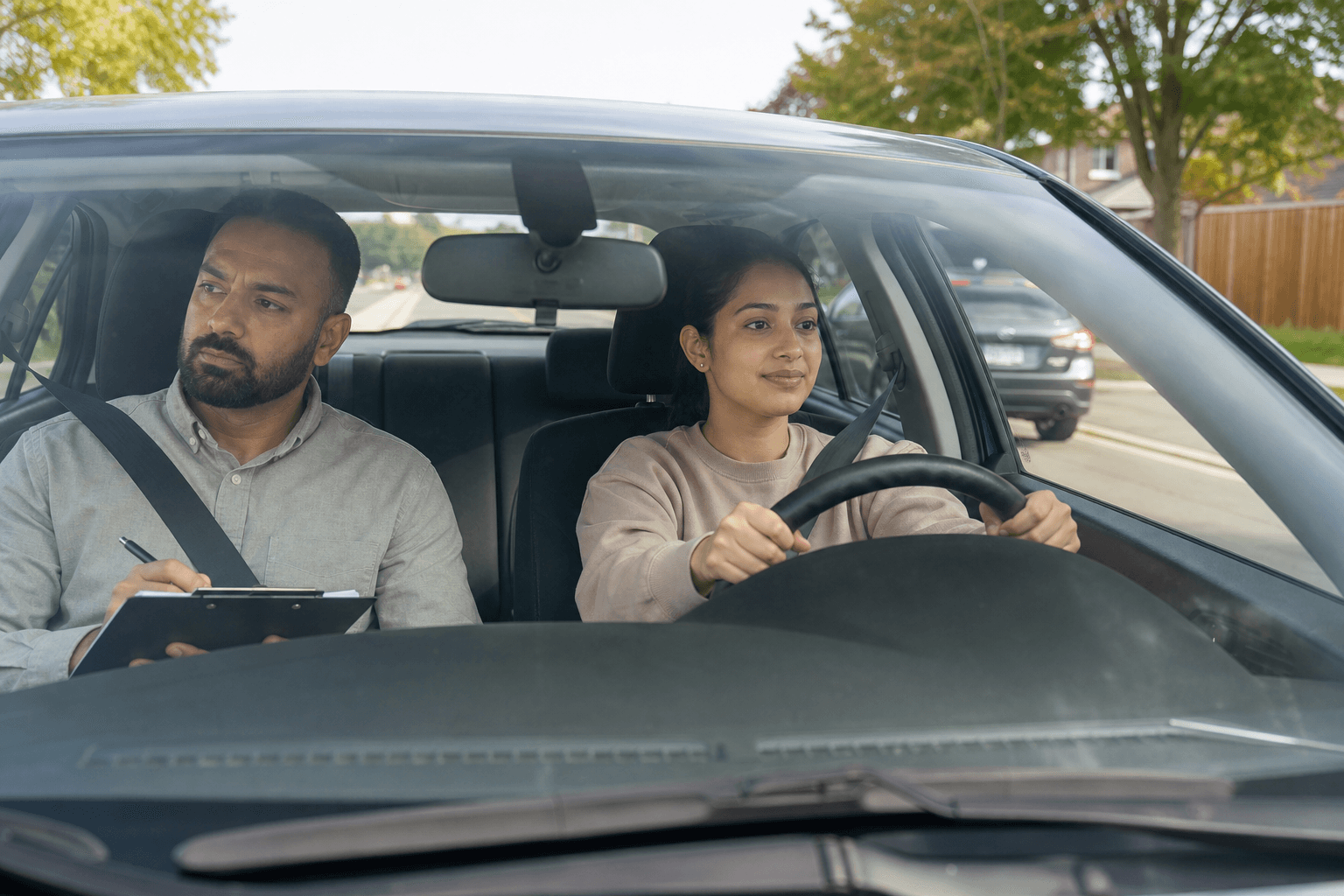
An in-car assessment is an instructor-led observation of your practical driving. You drive in real traffic while an instructor considers your vehicle control, observation, decision-making, and readiness for further practice. It can identify strengths and gaps, but it is not the official Ontario road test and does not guarantee a test result.
For learners in Brampton and the surrounding GTA, an assessment can answer a practical question: do you need general experience, focused skill-building, or road-test preparation? The answer depends on what you can do consistently behind the wheel, not only on what you have learned online.
Quick summary

- An in-car assessment observes practical driving in a supervised vehicle, rather than testing knowledge alone.
- An instructor may consider control, observation, signalling, lane changes, turns, speed management, positioning, and hazard decisions.
- It differs from a regular practice lesson, mock road test, online driver education, and the official road test.
- The feedback is most useful when it leads to a focused plan, such as individual lessons or targeted road-test practice.
What is an in-car assessment?
An in-car assessment is a structured driving observation. Instead of beginning with one predetermined lesson topic, the instructor watches how you approach common driving situations and uses that information to identify what should happen next.
The session may involve ordinary streets, intersections, lane changes, turns, parking situations, and traffic conditions appropriate to your experience. The instructor may give directions, ask questions, and provide safety guidance as needed. Confirm the route, duration, activities, and feedback method with the provider before booking.
An assessment should not be confused with an official scorecard or a formal Ministry of Transportation procedure. There is no single universal assessment format that automatically declares a learner ready or unready. Its value is diagnostic: it helps you and the instructor decide which skills deserve attention.
Online education can explain rules, signs, and safe-driving concepts, but it cannot show how you control a vehicle or respond to live traffic. A blended program that includes 10 in-car lessons gives learners supervised opportunities to apply knowledge with an instructor present.
What driving skills may be observed?

Assessment areas vary according to the learner’s experience and goals. These are common instructional focus areas, not a claim about a provider’s specific scoring system.
Vehicle control and positioning
An instructor may look at whether you accelerate, brake, steer, and maintain a suitable road position smoothly. They may also observe your control during starts, stops, turns, parking, and changes in road conditions.
Observation and awareness
Good driving involves more than looking directly ahead. The instructor may consider how you scan mirrors, check blind spots, notice pedestrians and cyclists, identify changing traffic conditions, and maintain awareness around the vehicle.
Signals, lane changes, and turns
Signalling at the right time, checking before moving, choosing a safe gap, and completing a turn in a suitable lane are practical behaviours an assessment may explore. The focus is on consistent habits, not one perfect manoeuvre.
Speed and following distance
An instructor may observe whether your speed suits the road, traffic, visibility, and weather. They may also look at following distance, braking decisions, and your ability to adjust without harsh or late actions.
Hazard recognition and decision-making
Feedback may address how you respond to parked vehicles, merging traffic, pedestrians, intersections, unexpected movement, and other developing hazards. A learner can know the correct rule but still need practice applying it early and confidently.
In-car assessment compared with other driving options
| Option | Main purpose | What you take away |
|---|---|---|
| In-car assessment | Identify current strengths, habits, and skill gaps | A practical picture of what to practise next |
| Regular practice lesson | Build or improve selected driving skills | Supervised repetition and instructor feedback |
| Mock road test | Rehearse the pressure and structure of a road-test-style drive | Experience with test-related routines and areas to refine |
| Online driver education | Study driving knowledge and safe-driving concepts | Flexible learning that does not replace vehicle practice |
| Official road test | Complete the licensing authority’s formal examination | An official licensing decision, not a coaching session |
A regular practice lesson is usually the better starting point when you already know the skill you want to improve, such as parallel parking or lane changes. An assessment is more useful when you are unsure why driving feels difficult, have not driven for some time, or want an instructor’s independent view before choosing a lesson plan.
A mock road test is narrower because it focuses on test-style performance. It can be valuable close to an examination, but it may not provide the broader diagnosis a learner needs earlier in training. Neither a mock road test nor an in-car assessment is the official road test.
Who may benefit from an in-car assessment?
Beginners
A beginner may use an assessment to establish a starting point after learning basic controls or completing introductory instruction. The goal is not polished performance. It is to identify which fundamentals need careful, supervised development.
Intermediate learners
An intermediate learner may drive comfortably in familiar areas but struggle with heavier traffic, complex intersections, lane changes, parking, or independent decisions. An assessment can help separate a confidence issue from a specific technical or observation habit.
Returning or refresher drivers
Someone returning to driving after a long break may benefit from an objective review before driving independently. A refresher assessment can identify which habits need rebuilding and whether the learner should begin with quieter streets or progress to busier routes.
Road-test candidates
A road-test candidate may use an assessment to check whether current practice addresses the right issues. Local instructors who work with learners in Brampton and the GTA can help put skills in the context of familiar roads and traffic situations. Local knowledge supports preparation, but it is not a prediction of the official result.
How to prepare for an in-car assessment
You do not need to perform perfectly. The instructor needs to see your current driving clearly, including habits you may not notice yourself.
- Confirm licence readiness: Bring the valid licence or permit required for the activity, and ask what documentation is needed.
- Set a clear goal: Explain whether you want a general review, confidence support, road-test feedback, or advice after a driving break.
- Describe recent experience: Mention how often you drive, where you usually drive, and which situations you avoid or find stressful.
- Wear suitable footwear: Choose shoes that let you feel and operate the pedals comfortably.
- Share concerns: Tell the instructor about recurring mistakes, nervousness, or manoeuvres that feel inconsistent.
- Ask about feedback: Confirm whether feedback is provided during the drive, afterward, or both, and whether priorities for further practice will be recommended.
Do not hide uncertainty to create a better impression. Accurate feedback is more useful than a session that shows only your most rehearsed route.
What to do after the assessment
Turn the feedback into a short practice plan. Ask the instructor to identify the two or three issues that affect safety or overall control most. For each issue, ask what successful performance looks like and how to practise it between lessons.
“Be more aware” is difficult to act on. A more useful explanation might identify late mirror checks before lane changes, insufficient following distance, or delayed responses at intersections. Specific observations make it easier to choose the next lesson and recognize improvement.
If the assessment reveals a narrow gap, individual lessons can provide focused practice before the road test. If several skills need work, a broader sequence of in-car instruction may be more appropriate than booking a single mock road test immediately.
After practice, another assessment can help determine whether the original concern is becoming consistent. The purpose is not to collect an informal pass or fail label. It is to confirm that the learner can apply the skill safely in more than one situation.
How HT Driving School’s in-car training fits into the picture
HT Driving School is based in Brampton and provides instruction for beginner, intermediate, and experienced drivers. Its listed approach combines self-paced learning with in-car instruction, and learners can ask about male or female instructors and scheduling when discussing their needs.
The school’s listed MTO-approved BDE structure includes 20 hours of self-paced online learning, 10 hours of self-paced Home Link, and 10 in-car lessons. This illustrates the relationship between knowledge and practical training: online study supports understanding, while supervised driving provides vehicle-control practice and real-time feedback.
Confirm current package inclusions, availability, and the type of assessment or road-test support you need before registering. A provider may offer practice before a test, a vehicle for local or distant test centres, or other support, but those details should be agreed in advance rather than assumed from the term “assessment.”
Frequently asked questions
Is an in-car assessment the same as an Ontario road test?
No. An in-car assessment is generally an instructional observation intended to identify strengths and areas for improvement. The official road test is a formal licensing examination with its own requirements and outcome. An assessment cannot replace it or guarantee that you will pass.
Is online driver education enough without in-car instruction?
No. Online education can provide flexible study of driving knowledge, but it cannot replace supervised vehicle operation, real-time feedback, or experience in live traffic. Practical driving requires opportunities to apply what you have learned.
What happens if an in-car assessment identifies skill gaps?
The instructor should help prioritize the gaps and recommend suitable practice. That may involve individual lessons, additional in-car instruction, refresher training, or focused road-test preparation. Ask for observable goals so you can tell when the skill is becoming consistent.
Should I book an assessment or a regular practice lesson before my road test?
Book an assessment when you want an independent review or are unsure what to practise. Book a regular practice lesson when you already know the skill you need to work on. If your main concern is test-day performance, ask whether a mock road test or targeted road-test preparation is more suitable.
Use the assessment to choose your next practice step
An in-car assessment is most useful when you treat it as a starting point for better practice. It can show how your knowledge translates into vehicle control, observation, communication, and decisions in traffic, while leaving the official licensing decision to the road test.
Before booking, decide what you want to learn from the session and ask how feedback will be used. Afterwards, focus on a small number of specific gaps, then choose individual lessons, broader in-car instruction, or road-test preparation that matches those findings.
For learners seeking Brampton driving lessons and supervised practical training, HT Driving School provides instruction for beginner, intermediate, and experienced drivers in Brampton and the surrounding GTA. Confirm current services, scheduling, and package details directly with the school.