
HT Driving School · 2026-09-30
Effective road sign recognition is more than memorizing pictures for the Ontario G1 knowledge test. You need to identify the sign, understand whether it communicates a law, warning, or direction, and choose the response that fits the road around you. Ontario traffic signs use shapes, colours, symbols, and wording to communicate information about laws, dangerous conditions, and navigation. The Official MTO Driver’s Handbook explains Ontario signs in these terms.
The same skill matters during supervised driving. A learner may know what a sign means during study but still miss it, interpret it too slowly, or fail to connect it with nearby traffic and hazards. The checks below help you practise recognition as a driving decision, not just a memory exercise.
What road sign recognition actually requires
Think of recognition as a three-part process: identify the sign from its visual features, interpret its message, and decide what action or preparation is needed.
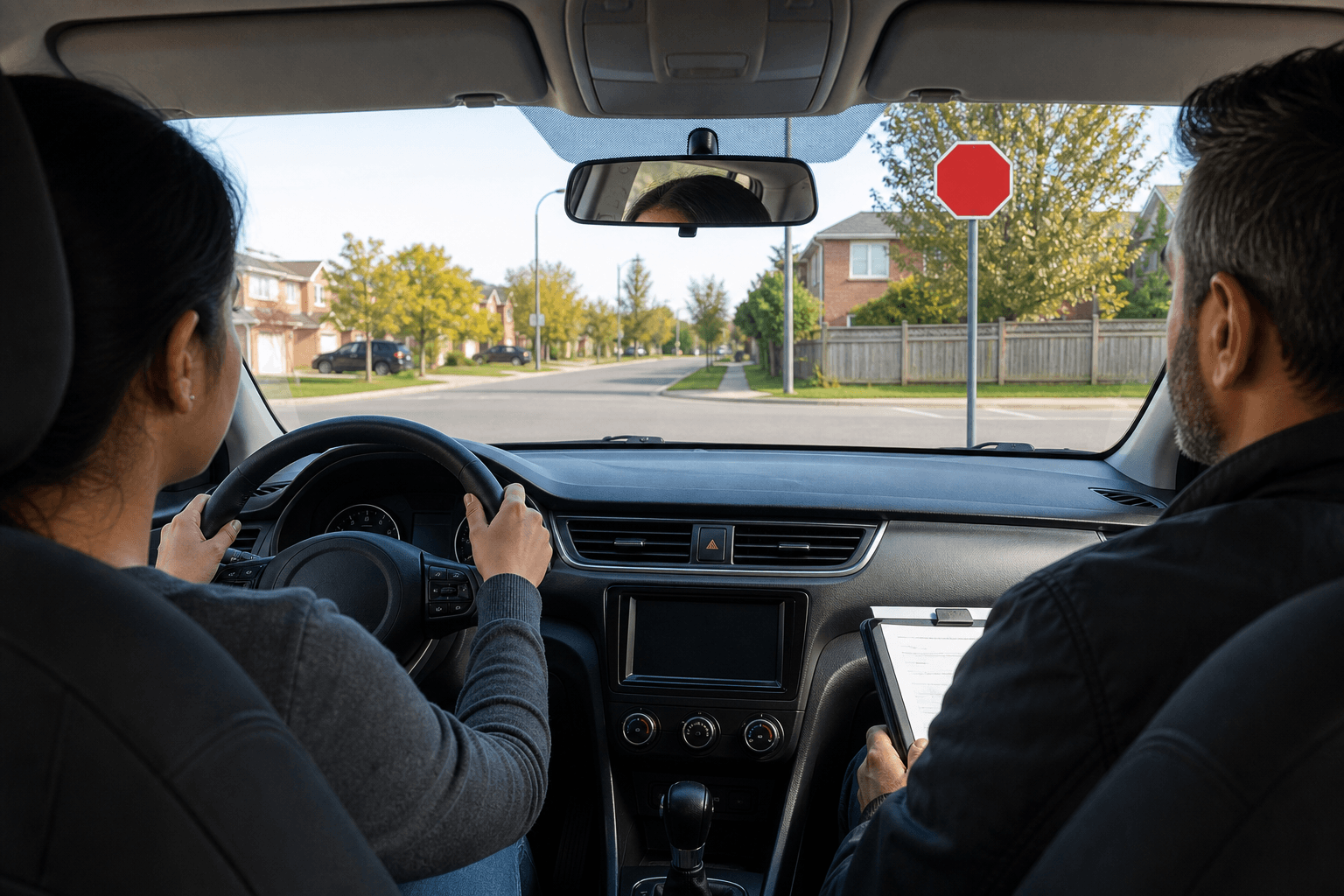
The official handbook identifies an Ontario stop sign as eight-sided, red, and marked with white letters. Its meaning is not simply “this is a red sign.” It requires a complete stop. Shape, colour, wording, and the required response work together.
Learning current road rules alongside sign recognition helps you move beyond picture matching. It also supports defensive driving and practical decision-making because signs provide information about what you should expect or do next.
Mistake 1: Using colour without checking the whole sign

Colour is useful, but it is not a complete interpretation. If you study by colour alone, you may recognize that a sign deserves attention without understanding its specific instruction, warning, or direction.
Ask four questions: What colour do I see? What shape is it? Is there a symbol or wording? What response does the complete sign require? This is more reliable than attaching one general meaning to every sign with a similar colour.
During practice, cover part of a sign and describe what information is missing. Then reveal the full sign and explain how the remaining clues confirm or change your interpretation.
Mistake 2: Overlooking sign shape
Shape can help you recognize a sign when lighting, distance, traffic, or visibility makes wording difficult to read. It should not replace reading the sign, but it can prompt you to pay closer attention.
The octagonal stop sign is a clear Ontario example. If you notice that distinctive shape ahead, you can begin preparing to stop before you are close enough to read every letter. The official handbook confirms both the eight-sided shape and the complete-stop requirement.
Do not turn shape into another shortcut. Combine it with colour, symbols, wording, and context. If the clues appear to conflict, slow down mentally and recheck the complete message instead of guessing.
Mistake 3: Confusing rules, warnings, and directions
Another problem is recognizing that a sign matters but not knowing what type of decision it prompts. Use this framework while studying:
| Information provided | What to examine | Response to practise |
|---|---|---|
| Rules or legal requirements | Shape, colour, wording, and symbols | Comply and make the required adjustment in good time |
| Warnings about dangerous conditions | The symbol or wording and the road area identified | Scan ahead and adjust your driving appropriately |
| Directions or navigation information | Words, arrows, route information, and direction | Plan your lane position and route without sudden movement |
This is a learning framework, not a complete catalogue of Ontario signs. The MTO handbook explains that signs communicate laws, dangerous conditions, and directions, using symbols, colours, and shapes to help identify them.
A warning is not the same as an instruction to stop, and directional information is not permission to change lanes immediately. After identifying the category, ask what decision it requires and how much time you need to make it safely.
Mistake 4: Recognizing the sign but reacting too late
Knowing a sign’s meaning in a flashcard exercise is different from noticing it early enough to respond. Late recognition can lead to abrupt braking, rushed lane changes, missed turns, or reduced attention to other road users.
Practise scanning farther ahead instead of looking only at the vehicle in front. When you notice a sign, continue checking traffic, road surfaces, pedestrians, cyclists, lane markings, and available space. The sign should guide your next decision without making you ignore everything else.
This is where hazard recognition training connects with sign study. Recognizing a sign early gives you information, but safe driving also requires assessing what is happening around it and responding without creating a new risk.
Mistake 5: Treating the sign as separate from the road
A sign does not exist in isolation. Its message relates to a particular road environment, even when you study it as a standalone image. A learner who can recite a definition may still need practice applying it while managing traffic, visibility, lane position, pedestrians, and changing conditions.
When you see a sign during a lesson, explain what you think it means and name what you are checking around it. Identify the instruction, look for the relevant roadway feature, check who else is affected, and decide whether you need to alter speed, position, or attention.
A quick recognition routine
- Identify: Notice the shape, colour, symbol, and wording.
- Classify: Decide whether it communicates a rule, warning, or direction.
- Interpret: State the message in your own words.
- Scan: Look at the roadway and nearby road users.
- Respond: Choose the required action early and carry it out smoothly.
If you cannot complete one step, mark that sign for further study. Repeating a picture until it feels familiar is less useful than explaining what it means and what you would do on the road.
A self-check before the G1 test or a lesson
- Can I identify the sign without relying on its position on a page?
- What do its shape, colour, symbol, and wording each contribute?
- Does it communicate a rule, warning, or directional information?
- What does it require me to do, prepare for, or locate?
- What nearby hazards or road users should I scan for?
- What could make the response more difficult, such as reduced visibility or changing traffic?
Practise saying the answer aloud, writing it down, or explaining it to an instructor. If you know the sign but cannot state the response, you have identified a useful preparation gap.
G1 preparation and in-car practice are different
Studying Ontario traffic signs supports the knowledge component of learner preparation. In-car instruction adds a different challenge: noticing signs in real time, managing the vehicle, observing traffic, and applying the relevant rule without losing awareness of the wider situation.
HT Driving School is an MTO-approved Beginner Driver Education provider serving Brampton and nearby communities. Its listed BDE structure combines self-paced online learning with in-car instruction, including 20 hours of online learning, 10 hours of Home Link, and 10 in-car lessons. Confirm current package details before registering.
Road sign recognition can support safe-driving instruction, but it does not guarantee a G1 pass, road-test pass, licence, or collision-free driving. Those outcomes depend on meeting applicable requirements and demonstrating the necessary knowledge and skills.
Questions to ask before choosing driver training
- How will the course explain sign shapes, colours, symbols, and wording instead of relying only on memorization?
- Will I practise identifying a sign and explaining the response it requires?
- How are current road rules, defensive driving, and practical decision-making included?
- How will lessons be adapted for a beginner, intermediate learner, or refresher student?
- What online and in-car components are included in the BDE package?
- Can I request a male or female instructor, subject to scheduling and location?
- What should I confirm separately about road-test preparation, vehicle availability, scheduling, and fees?
Be cautious of explanations that promise a test result simply because you memorized images. Also distinguish driver education from unrelated automated technology. License plate recognition on private properties concerns vehicle-identification systems, not the learner skill of interpreting Ontario traffic signs.
Frequently asked questions
Is road sign recognition only important for the Ontario G1 knowledge test?
No. It supports G1 preparation, but drivers also need to notice and interpret signs while managing traffic and road conditions. The practical goal is timely, appropriate decision-making.
Why does the shape of an Ontario road sign matter?
Shape is one visual clue that can help you notice and identify a sign when distance, lighting, or visibility makes other details harder to read. Combine it with colour, symbols, wording, and the actual instruction.
What should I do when I recognize a sign but do not understand the response?
Do not guess. Review the sign in the official handbook, state its message in your own words, and ask an instructor how to apply it safely in context.
How can supervised lessons improve practical recognition?
Supervised lessons let you practise spotting signs early, maintaining control, scanning hazards, and applying the relevant rule. Ask the instructor to have you explain your decisions.
Turn sign recognition into a driving decision
Use the complete sign, identify the type of information it provides, interpret its message, scan the road, and respond early enough to remain smooth and controlled. Shape and colour are helpful clues, but neither replaces understanding the wording, symbol, or required action.
Use the Official MTO Driver’s Handbook for knowledge-test study, then reinforce that learning through supervised practice. For tailored instruction, flexible online and in-car training, or beginner, intermediate, and refresher driving support in Brampton and nearby communities, visit HT Driving School.