
HT Driving School · 2026-09-25
Effective parallel parking practice is not about repeating the entire manoeuvre without knowing what went wrong. A better approach is to break it into separate skills, practise each one deliberately, and then combine them in a controlled sequence. This helps you identify whether the problem is your starting position, observation, steering timing, reversing control, or final alignment.
Parallel parking is one of the basic skills assessed on Ontario’s G2 road test, but one successful attempt does not automatically make the manoeuvre reliable. Use these drills to build consistent control before adding busier traffic, unfamiliar spaces, or broader road-test preparation.
Set Up Parallel Parking Practice Safely
Choose a location where you can practise legally without creating a hazard for other road users. A quiet street or another suitable area may work, but do not assume a particular location is officially approved for driver training. Look for clear sightlines, manageable traffic, and enough room to stop safely if you need to reset.
Before beginning, become familiar with the vehicle’s mirrors, steering response, pedals, and blind spots. Practise with an accompanying driver who is legally permitted to supervise you where applicable. The supervising person should give concise feedback rather than making every decision for you.
For Ontario practice, the official handbook recommends a parking space about one and one-half times the length of your vehicle. It also describes checking traffic, signalling, and positioning beside the vehicle ahead before beginning. Review the Ontario parking guidance before practising.
Drill 1: Choose the Space and Build the Starting Position

Do not begin by reversing immediately. First practise approaching the space, deciding whether it is suitable, signalling, and stopping beside the vehicle ahead with a consistent gap. This isolates the part of parallel parking that determines your angle and available room.
Ask yourself: Is the space long enough? Is the traffic situation clear? Am I positioned parallel to the vehicle ahead rather than approaching diagonally? Repeat the setup until you can place the vehicle calmly without repeated repositioning.
Drill 2: Practise the Observation and Signal Sequence
Practise communication and observation without focusing on steering. Signal before moving toward the space, check around the vehicle, use your mirrors, and check both blind spots. Wait until the path is clear before reversing.
The goal is to make observation part of the manoeuvre rather than an afterthought. The Ontario handbook advises checking all around the vehicle, the mirrors, and both blind spots before backing up. The handbook’s reversing guidance is a useful reference for this drill.
Drill 3: Reverse Slowly With Consistent Vehicle Control
Once your setup and checks are consistent, focus on reversing at a controlled speed. Keep your attention moving between the direction of travel, mirrors, blind spots, and the surrounding environment. Avoid accelerating to make the manoeuvre feel easier or rushing because another vehicle is waiting.
Your observer should watch for smooth pedal control, unnecessary stops, and moments when your attention stays in one place too long. If the path changes or you become uncertain, stop safely, re-check the surroundings, and decide what to do next.
Drill 4: Practise Steering Timing Without Guessing
Steering timing is often the source of a repeated error. Turning too early may bring the rear of the vehicle too close to the vehicle behind or create a poor entry angle. Turning too late may leave you too far from the curb or force a large correction.
Repeat the entry phase while changing only one factor at a time. Keep your starting position similar, then observe what changes when you begin steering earlier or later. Fixed reference points can help temporarily, but they are not universal rules. Vehicle size, seating position, mirror adjustment, space dimensions, and road slope can all affect what you see.
Drill 5: Finish With Curb Alignment and Space Awareness
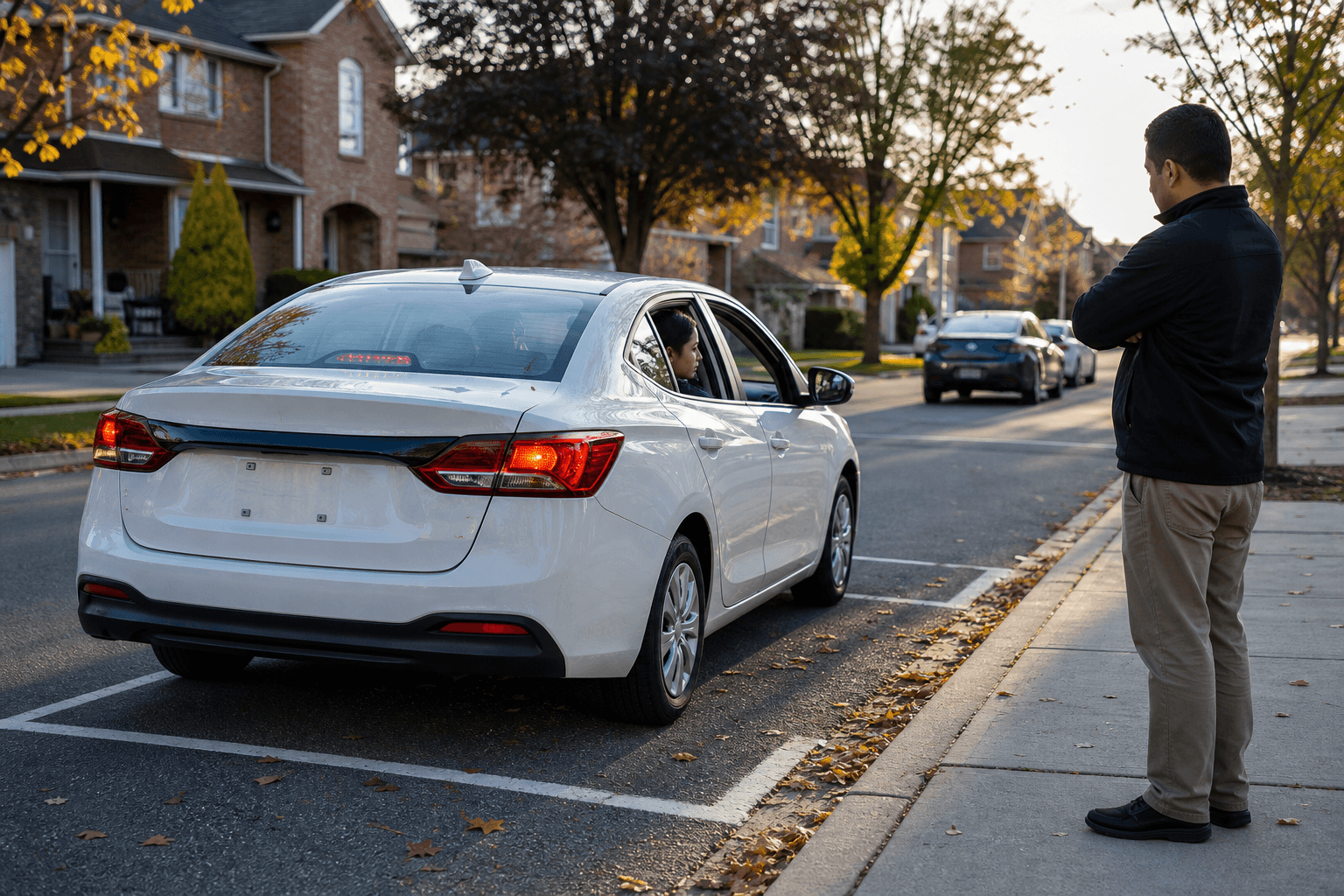
After entering the space, assess the finish rather than immediately declaring success. Is the vehicle reasonably aligned with the curb? Is it within the available space? Is there adequate clearance from vehicles ahead and behind? Can you complete the manoeuvre without losing awareness of nearby traffic?
Ontario guidance describes steering toward the curb while reversing and then steering to bring the vehicle in line with it. Use that principle to evaluate your finish, not as a reason to force the vehicle into position with abrupt steering.
Drill 6: Practise Safe Corrections Instead of Rushing
A correction is not automatically a failure. It becomes a problem when you make it without checking the surroundings or rush because the original approach was not working. If you finish too far from the curb or at an awkward angle, pause, check around the vehicle again, and make a controlled adjustment when the path is clear.
Practise correcting one condition at a time. For example, begin with a vehicle slightly too far from the curb and focus on improving alignment. Then practise recovering from an entry angle that is too shallow. This is more useful than repeating full attempts while changing several decisions at once.
A Parallel Parking Practice Sequence to Repeat
This is an editorial practice framework, not an official Ontario scoring rubric or required number of repetitions. Move forward when the skill is becoming consistent and observable, not because you have completed a fixed count.
| Drill | Skill focus | What to observe | Progression cue |
|---|---|---|---|
| Space and position | Approach and starting alignment | Space suitability, signal, parallel position, traffic | Set up without repeated repositioning |
| Observation sequence | Communication and awareness | Mirrors, blind spots, surroundings, clear path | Check deliberately before every movement |
| Controlled reversing | Low-speed vehicle control | Smooth movement, steady attention, safe pauses | Reverse without rushing |
| Steering timing | Entry angle and turning input | Early, late, or excessive steering | Adjust one variable and explain its effect |
| Curb alignment | Finishing position | Alignment, clearance, space awareness | Evaluate the finish objectively |
| Safe correction | Recovery and decision-making | Re-checks, controlled movement, final position | Correct without rushing or guessing |
Progress From Controlled Repetition to Real-World Practice
Once the sequence feels manageable, add variation gradually. Practise with spaces that differ in length, use more than one starting position, and work in surroundings that require you to notice changing traffic. Do not add every challenge at once. The goal is to determine whether your observation and control transfer beyond one familiar setup.
After each session, note what went well, the most common error, and the single adjustment you will test next. If parallel parking is part of broader preparation, combine these drills with G road test prep that includes a wider readiness check and test-day plan.
Troubleshoot the Most Common Parallel Parking Errors
Ending too far from the curb
Check the starting position and first steering input before simply turning more sharply. A poor entry angle can leave you too far away even when the final steering movement seems correct.
Turning too early
If the rear moves too close to the vehicle behind or the entry angle is awkward, your steering input may begin too soon. Reset beside the vehicle ahead and delay only that steering decision while maintaining the same observation routine.
Turning too late
A late steering input may leave the front outside the space or require a large correction. Focus on how the vehicle’s position changes instead of waiting for a memorized landmark.
Losing awareness while reversing
If you focus on the curb or steering wheel and stop checking the environment, slow down or stop. Rebuild the sequence of mirror checks, blind-spot checks, and all-around observation. If repeated parallel parking drills do not correct the same mistakes, targeted practice with an instructor may help identify the underlying issue.
When Targeted Instruction Can Improve Your Practice
Independent practice can be productive when you have a suitable vehicle, a legal practice area, and someone who can give calm, specific feedback. Professional input may help when the same error keeps returning, you are unsure whether your checks are complete, or you cannot identify which part of the sequence is causing the problem.
HT Driving School provides in-car instruction for beginner, intermediate, and experienced drivers, along with refresher training and road-test preparation. Its local male and female instructors tailor lessons to learner needs.
Road-test support can also involve planning beyond parking. Depending on the package, HT Driving School offers practice before the test and access to a vehicle for local or distant test centres. Confirm current inclusions and availability before booking.
Parallel Parking Readiness Checklist
- I can judge whether a space is suitable for my vehicle.
- I signal and check traffic before moving toward the space.
- I check around the vehicle, use the mirrors, and check both blind spots before reversing.
- I can reverse slowly without rushing or relying on constant prompts.
- I understand whether my steering input is early, late, or excessive.
- I can finish reasonably aligned with the curb and within the available space.
- I can pause, re-check, and make a controlled correction when needed.
- I have practised in more than one suitable setting.
- I can describe my most common error and the adjustment I am testing next.
Readiness means repeatable control and awareness, not perfection on one attempt. Parallel parking is one part of broader road-test preparation, so continue practising other required driving skills.
FAQ About Parallel Parking Drills
How large should a parallel parking space be for practice in Ontario?
Ontario’s official driver handbook recommends a space about one and one-half times the length of your vehicle. That is a useful starting reference, but practise in varied spaces only when you can maintain safe observation and control.
Should I memorize fixed reference points for parallel parking?
Reference points can help you understand when to begin steering, but they should not replace observation. They may change with the vehicle, seating position, mirror adjustment, space size, and road slope. Learn what the vehicle is doing and use reference points as supporting cues.
When should I practise parallel parking in busier conditions?
Move beyond a predictable setup when you can consistently signal, check the surroundings, reverse slowly, steer deliberately, and finish with reasonable alignment. Add traffic and unfamiliar surroundings gradually. If you stop checking around you, return to a simpler setting.
Does parallel parking practice cover everything needed for an Ontario G2 road test?
No. Parallel parking is one basic skill included in the G2 road test. Broader preparation also requires practice with other driving situations and decisions, so do not rely on one manoeuvre alone.
Conclusion: Turn Parallel Parking Into a Repeatable Skill
The most useful parallel parking drills isolate the decisions that make the manoeuvre work: selecting a suitable space, positioning correctly, communicating, checking the surroundings, reversing slowly, timing the steering, aligning with the curb, and correcting safely. Practise those elements in order, change one variable when troubleshooting, and add varied conditions only after the basics are consistent.
If you are practising in Brampton or elsewhere in the GTA and want feedback on your parking, general driving, or road-test plan, HT Driving School offers in-car instruction and road-test support, including applicable package options for practice and test vehicles. Confirm current service details and package inclusions before booking.