HT Driving School · 2026-10-12
If you are searching for dual-brake training cars in Mississauga, ask more than whether a driving school has a vehicle with an extra brake. Confirm that the instructor-operated brake is used during your lessons, that the vehicle is properly equipped, and whether a suitable school vehicle is available for your road test.
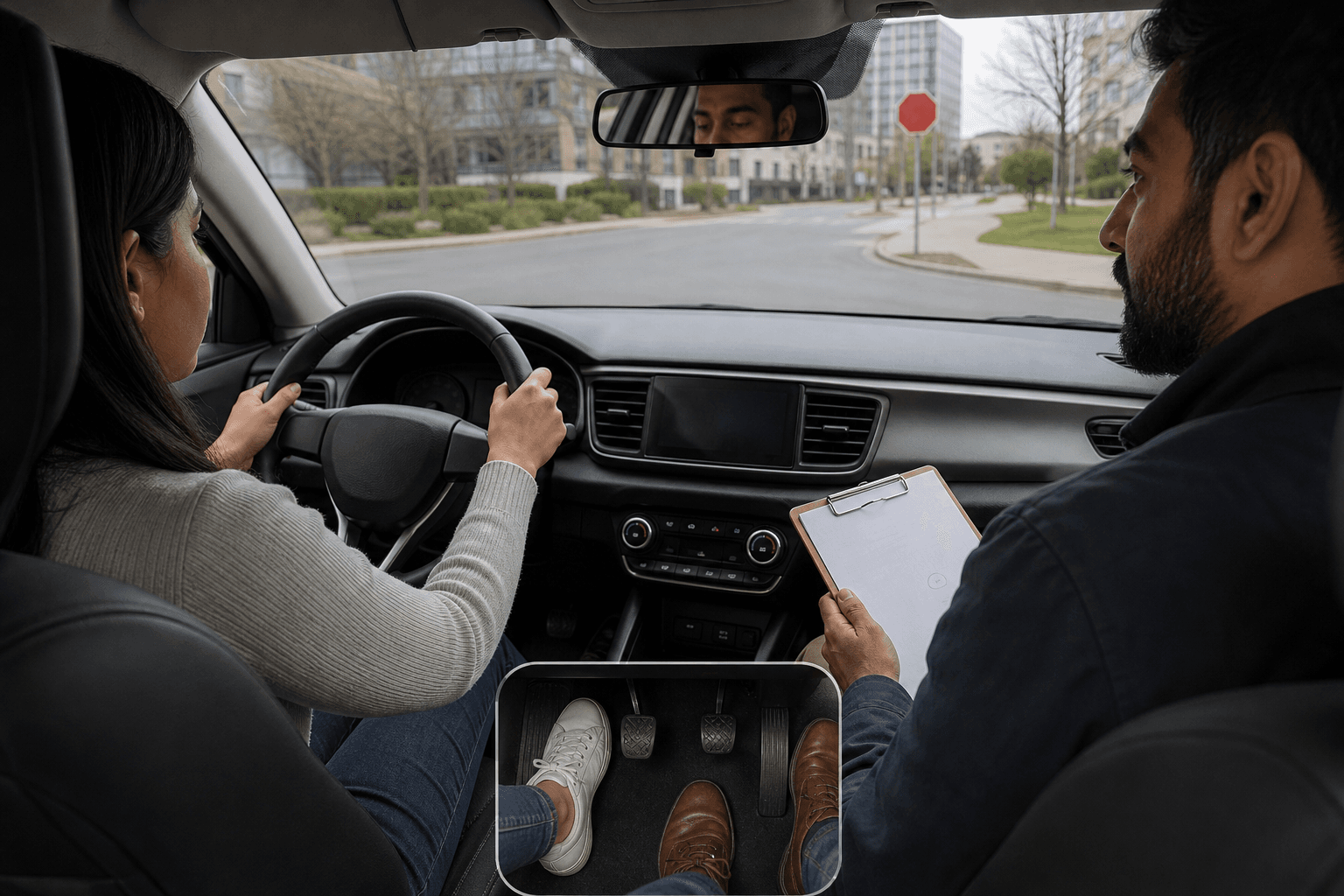
A dual-brake or dual-control vehicle gives the instructor an additional braking control while you practise in traffic. It can support safer instruction, but it does not replace coaching, observation, or your responsibility as the driver. Before booking, ask exactly what your package includes and which vehicle will be used.
Quick summary

- Ask whether your scheduled in-car lessons use a vehicle with an instructor-operated dual brake.
- Do not assume that a dual-brake lesson vehicle is automatically included for your road test.
- Confirm the pickup area, vehicle condition, instructor options, scheduling terms, and additional charges.
- Choose safety-focused coaching and practical instruction, not equipment claims alone.
- For an MTO-approved BDE course, confirm how online learning, flexible learning hours, and in-car lessons fit together.
What a dual-brake training car is
A dual-brake training car has an additional brake control that allows the instructor to assist with braking from the passenger side when necessary. You may also see this described as a dual-control vehicle, instructor brakes, dual braking equipment, or a service brake actuator.
The terminology varies between driving schools and government materials. Ontario’s official vehicle requirements refer to a dual brake and include the term “service brake actuator,” while Mississauga materials may use “dual braking equipment.” The practical question is whether the instructor can operate a separate braking control during your in-car training.
This equipment is a safety aid while you learn vehicle control, traffic observation, stopping, lane changes, and other driving skills. It is not a guarantee that you will pass a road test or prevent every collision. Instruction and deliberate practice remain essential.
Compare the vehicle options before you book

These arrangements are often confused. A school may offer a dual-brake vehicle for lessons, a vehicle for a road test, or both. Ask about each service separately rather than treating “training car” as a complete description.
| Vehicle arrangement | What it provides | What to confirm |
|---|---|---|
| Ordinary lesson vehicle | Practice with an instructor, potentially without an additional brake. | Whether it has dual braking equipment and whether it is used for your lesson. |
| Dual-brake training vehicle | In-car instruction with an additional braking control available to the instructor. | Whether every relevant lesson uses it, who operates the control, and whether it is maintained and insured. |
| Vehicle supplied for a road test | A school vehicle arranged for a local or distant test centre. | The test-centre location, pickup time, vehicle inclusion, practice before the test, and any extra cost. |
A vehicle supplied for a road test is not necessarily the vehicle used for all your lessons. Similarly, having dual brakes during lessons does not automatically mean that a road-test vehicle is included. Get the arrangement confirmed before you pay or schedule the test.
Why instructor-operated braking matters during lessons
New drivers can misjudge a stop, hesitate at an intersection, drift during a lane change, or react late to a developing hazard. An additional instructor-operated brake gives the instructor another way to respond while explaining what happened and helping the learner regain control.
The equipment is most useful when paired with practical driving skills and safe decision-making in real traffic. Lessons should progressively build your ability to scan for hazards, maintain a safe position, judge speed and space, and respond without relying on the instructor’s intervention.
Do not choose a school solely because it advertises dual-brake vehicles. Ask how the instructor uses the equipment, what skills the lesson will cover, and how progress will be assessed. A safety feature supports training, but cannot substitute for consistent practice.
Ontario safety and approval checks
Ontario advises consumers to avoid training vehicles that are not properly equipped with a dual brake. The province also warns against guaranteed licences, promises to pass without a road test, requests for certification without completed training, or cash-only payment without a receipt. Review the guidance on government-approved driving schools.
Approved driving-school vehicle requirements also address insurance and safety documentation. Ontario’s guidance includes a dual brake, appropriate insurance, and other vehicle documentation. You do not need to inspect every document yourself, but a school should be able to answer reasonable questions about its training vehicles and payment arrangements.
Be cautious if an advertisement uses “dual-control” as a vague selling point but will not confirm whether the equipment is installed in the vehicle assigned to you. A clear answer about the vehicle, instructor, lesson coverage, and receipt is more useful than an unsupported guarantee.
How dual-brake vehicles fit into an MTO-approved BDE course
An MTO-approved Beginner Driver Education course combines knowledge learning with practical instruction. HT Driving School describes a structure that includes 20 hours of online learning, 10 hours of Home Link learning, and 10 in-car lessons. The school serves learners in Brampton, Mississauga, Etobicoke, Toronto, and the surrounding GTA.
Confirm two separate details. First, understand which learning components are included in your selected BDE package. Second, ask which vehicle will be assigned to your in-car sessions and whether it has an instructor-operated dual brake.
Completing online coursework does not confirm the details of your practical training. Ask about the lesson schedule, meeting location, instructor, and vehicle before your first session.
Questions to ask a driving school serving Mississauga
Use this checklist when comparing dual-control vehicles in Mississauga:
- Equipment: Does the vehicle assigned to my lesson have an instructor-operated dual brake? Is it used for every scheduled in-car lesson?
- Instruction: How will the instructor use the additional brake while I build independent control and hazard-awareness skills?
- Vehicle: Is the training vehicle maintained, properly insured, and equipped for driver instruction?
- Instructor: Who will teach me, and can I request a male or female instructor based on availability?
- Location: Where will lessons begin in Mississauga, and is pickup or drop-off available?
- Schedule: What lesson times, rescheduling rules, and cancellation terms apply?
- Package: Does the price include only BDE lessons, or also a road-test vehicle and practice before the test?
- Road test: Which test centres are covered, and what additional charges apply?
HT Driving School’s FAQ confirms an MTO-approved Beginner Driver Education program, male and female instructor options subject to scheduling and location, and packages that can include a vehicle for local or distant road tests. Confirm the details of your own package rather than assuming every option is included.
Do you also need a car for the road test?
If you do not have access to a suitable vehicle, ask for road-test support when booking lessons. Confirm the test centre, arrival time, whether the vehicle is reserved for your appointment, and whether a practice lesson before the test is included or charged separately.
HT Driving School states that its package options can include a car for a local test centre, a centre up to one hour away, or a centre one to two hours away. The school also describes practice before the test and early road-test booking as package features. Availability and inclusion depend on the selected arrangement, so confirm the scope directly.
A dual-brake training car and a road-test car serve different purposes. During instruction, the extra brake supports the instructor. At the road test, confirm that the vehicle is available and suitable for the appointment, and clarify what support is provided beforehand.
Choosing the right Mississauga training arrangement
Beginners starting from scratch may benefit from the full BDE structure if the online and in-car components fit their schedule. Ask specifically about the vehicle assigned to the 10 in-car lessons and choose a program that gives you enough opportunity to practise safely and receive useful feedback.
A learner with basic experience may need targeted in-car driving lessons instead of a complete beginner program. Focus on skills such as intersection decisions, lane changes, parking, highway entry, or observation. A dual-brake vehicle can add reassurance while those skills develop, but lessons should still encourage independent decisions.
Experienced drivers may be looking for refresher driving lessons, defensive driving training, or collision prevention training. Ask for instruction focused on hazard recognition and safe-driving knowledge, not only road-test manoeuvres. Male or female instructor preferences can also be discussed, subject to scheduling and location.
Frequently asked questions
Does every driving lesson in Mississauga use a dual-brake vehicle?
Not necessarily. Confirm whether a dual-brake vehicle is assigned to every in-car lesson in your package or only selected sessions.
Is a dual-brake training car the same as a car provided for a road test?
No. Dual brakes describe equipment used to support instruction. A road-test vehicle is a separate service reserved for a particular test centre and appointment.
Can I request a male or female instructor for lessons in Mississauga?
You can ask about your preference. HT Driving School states that male and female options are available subject to scheduling and location.
What should I confirm if I need a car at a distant road-test centre?
Provide the exact location and ask whether the school can supply the vehicle there, when you will meet the instructor, whether practice is included, and what extra charges apply.
Confirm the vehicle before you commit
The best choice is not simply the school with the most prominent dual-brake claim. Choose an arrangement where the vehicle equipment, instructor support, lesson coverage, safety expectations, and road-test services are clearly explained before booking.
If you are comparing dual-brake training cars in Mississauga, ask whether your specific lessons use instructor-operated braking and whether your package includes a road-test vehicle. For local or distant test-centre support, instructor options, and BDE details, contact HT Driving School and confirm the vehicle arrangement for your schedule.