
HT Driving School · 2026-09-24
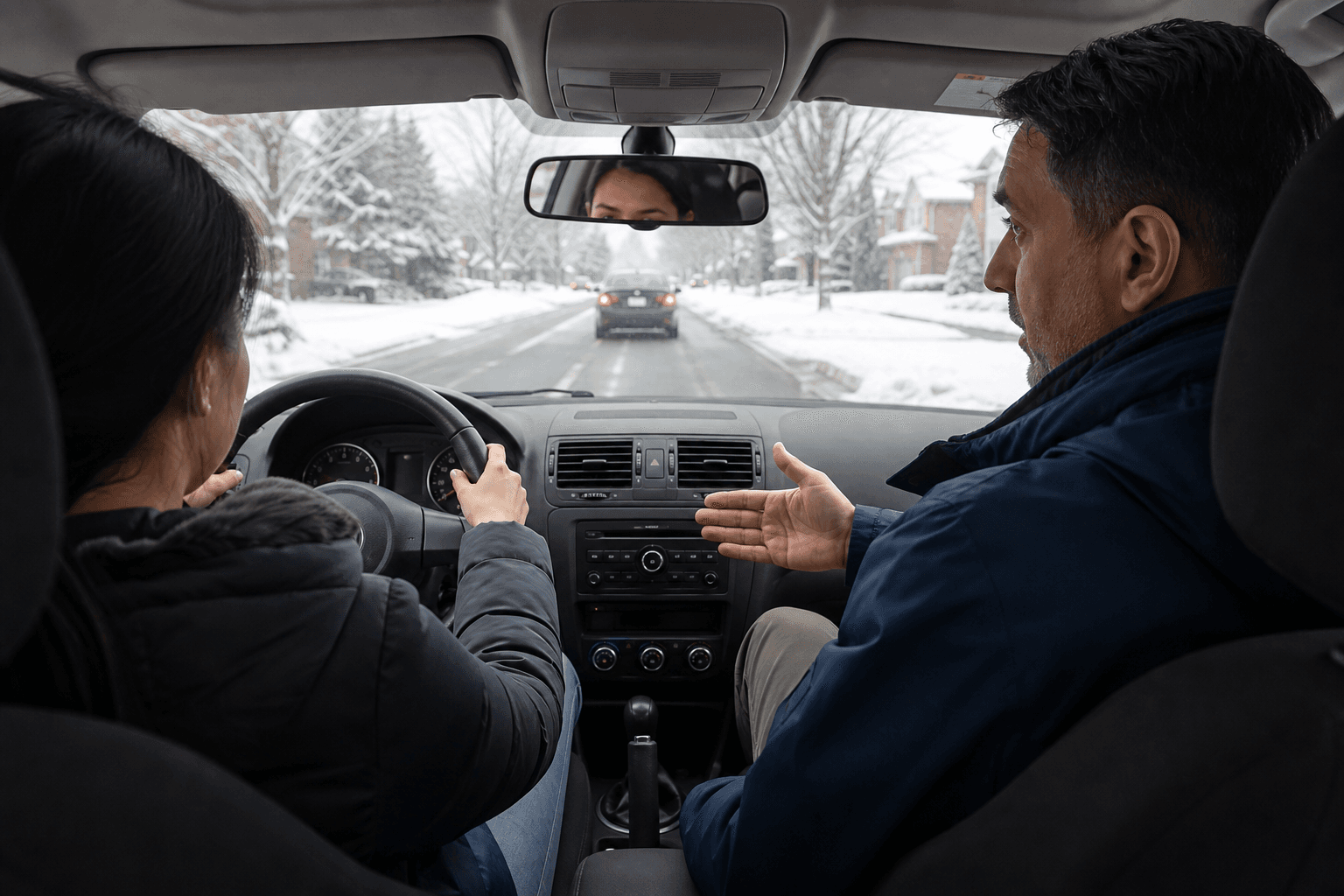
Winter driving lessons can help you prepare for reduced visibility, changing road surfaces, longer stopping distances, and the need for smoother vehicle control. The most useful preparation combines winter-driving theory with supervised in-car practice, but confirm the instructor’s approach, vehicle, weather policy, and availability before booking.
For learners in Brampton and the surrounding GTA, the right choice may be an MTO-approved Beginner Driver Education course, individual instruction, refresher driving lessons, or focused additional practice. Your experience and the skills you want to improve should guide that decision.
Quick summary

- Prioritize speed control, following distance, visibility, smooth braking, steering, and hazard awareness.
- Online learning can explain winter-driving principles, but it cannot replace vehicle-control practice or live instructor feedback.
- Ask whether the lesson can focus on braking, turning, observation, confidence, or road-test preparation.
- Confirm the instructor, vehicle, lesson area, weather policy, schedule, cancellation terms, and current availability.
- Do not assume a lesson will take place in snow or ice. Safe conditions should be assessed by the instructor.
What winter driving lessons should cover
A useful winter lesson is not simply a regular session with seasonal wording. Ask the instructor to connect the lesson to the conditions you may face while keeping practice safe and appropriate for your experience.
Speed and space management
Winter driving requires adapting speed to visibility, traction, traffic, and road conditions. The City of Brampton’s winter-driving advice emphasizes staying alert, slowing down, remaining in control, and maintaining a safe following distance.
During a lesson, ask for feedback on whether you are leaving enough space, approaching intersections at a suitable speed, and reducing speed early rather than braking sharply at the last moment. These habits require observation and coaching, not just memorizing a rule.
Braking, steering, and acceleration
Winter practice should emphasize smooth inputs. Abrupt acceleration, heavy braking, or sudden steering can make control more difficult when traction is limited. An instructor may help you look farther ahead, ease off the accelerator in good time, and keep steering movements measured.
Ask which exercises are appropriate for your vehicle and experience. You should not expect every lesson to include emergency manoeuvres, skid recovery, or severe-weather practice. The instructor should decide what is safe and relevant.
Visibility and hazard recognition
Snow, spray, glare, darkness, and covered road markings can make hazards harder to see. Winter lessons should address mirror use, scanning, blind spots, pedestrian awareness, lane positioning, and responses to unpredictable road users.
Alongside winter driving lessons, collision prevention training may be relevant if you want structured help with hazard recognition, reducing collision risk, and building safer driving habits. Confirm which topics are included in the instruction you are considering.
Vehicle control in changing conditions

Conditions can change between a clear intersection, a shaded section, a bridge, a residential street, and a busy route. The goal is to recognize those changes and adjust speed and space accordingly, rather than treating every road as equally slippery.
Useful questions for an instructor include:
- How will we practise smooth braking and acceleration?
- Will the lesson cover turns, intersections, lane changes, and stopping distances?
- How can I identify hazards before they become urgent?
- What happens if conditions become unsuitable during the lesson?
Brampton’s guidance also encourages drivers to consider a winter vehicle tune-up. A driving lesson cannot replace maintaining the vehicle, clearing windows and lights, or following the manufacturer’s requirements. Ask how the training vehicle is checked before instruction and what safety equipment is available.
Online theory versus in-car winter practice
Online study is useful for learning terminology, reviewing safe-driving principles, and preparing questions for an instructor. It can fit around school or work, but it cannot show how your braking, steering, observation, or speed choice performs in actual traffic.
HT Driving School describes its BDE pathway as a combination of self-paced online learning, Home Link, and in-car lessons. The listed structure includes 20 hours of online learning, 10 hours of Home Link, and 10 in-car lessons. Its explanation of in-car lessons and 20-hour e-learning distinguishes online study from practical vehicle-control feedback.
The distinction matters if your concern is winter confidence. Theory can prepare you to understand following distance, visibility, and speed management. In-car instruction allows an instructor to observe your decisions and provide immediate feedback.
Ontario states that government-approved driving schools meet requirements for in-class and in-vehicle training. Approved training may also help learners qualify for insurance savings or take the G1 exit road test sooner, but confirm eligibility and any discount directly with your insurer.
Which lesson format fits your winter-driving goal?
Winter driving lessons are not one standard product. Use this comparison to identify the type of support that best matches your starting point.
| Lesson format | May suit you if | Confirm before booking |
|---|---|---|
| MTO-approved BDE course | You are a new driver seeking structured education, online learning, in-car instruction, and an MTO certificate. | Current structure, certification requirements, scheduling, vehicle arrangements, and whether your winter goals can be addressed. |
| Individual lesson | You have a focused concern, such as braking, turning, visibility, or changing road surfaces. | Lesson length, price, pickup area, instructor availability, and the skills covered. |
| Refresher instruction | You have not driven recently or want to update your habits before regular winter driving. | Your experience, difficult areas, and how the instructor will address those gaps. |
| Additional practice | You have completed training but want more supervised driving before independent driving or a road test. | Which manoeuvres need practice and the current lesson or package inclusions. |
HT Driving School provides instruction for beginner, intermediate, and experienced drivers, with local male and female instructors who tailor lessons to learner needs. Its listed BDE offering includes online learning and in-car instruction, while individual lessons and additional practice options are also described as available. Review the current details for individual lessons and additional practice before deciding.
Winter driving lesson booking checklist
- Instructor fit: Ask whether the school can match your experience, preferred teaching style, and male or female instructor preference.
- Lesson objective: Confirm whether you can focus on braking, turning, observation, following distance, visibility, confidence, or road-test preparation.
- Vehicle condition: Ask whether the training vehicle is well maintained and whether dual brakes are available where relevant.
- Weather policy: Find out what happens if visibility is poor, roads become unsafe, or the instructor changes the planned session.
- Actual conditions: Ask whether the school promises any particular weather. Seasonal preparation is not a guarantee of snow or ice.
- Service area: Confirm pickup and instruction areas in Brampton or the wider GTA.
- Schedule: Check lesson duration, available times, cancellation terms, and instructor availability.
- Total cost: Ask what is included and whether taxes, vehicle charges, or extra practice are separate.
Planning winter practice in Brampton
Local context can help you set realistic goals. Brampton’s official advice focuses on alertness, reduced speed, control, safe following distance, and adapting to weather and road conditions. These priorities are more useful than choosing a lesson solely because it promises a particular route or type of weather.
The city permits licensed driving school instructors and operators to use designated recreation-centre parking lots for driving instruction seven days a week. This is general municipal context, not a promise that a particular school will use a specific lot or that it is a winter-training facility. Confirm the location directly with the school.
Before booking, list the situations that concern you most. These might include starting and stopping smoothly, approaching turns, seeing through glare or snowfall, maintaining space, or staying calm when traffic conditions change.
When individual or extra practice may help
Additional practice can be useful when you understand the theory but still need feedback behind the wheel. A returning driver may want to rebuild confidence gradually, while a newer driver may need repeated coaching on speed control, lane position, or observation.
Extra lessons should have a clear purpose. Ask the instructor to identify the skill gap, explain what will be practised, and tell you how to judge whether you are ready to continue independently. Road-test preparation can review observation, turns, stops, and decision-making without assuming the test will occur in snow.
Frequently asked questions
Can online BDE learning replace in-car winter driving lessons?
No. Online BDE learning can explain safe-driving principles, but it cannot provide vehicle-control practice or live feedback on speed, braking, steering, observation, and decisions.
Can a driving school guarantee that a lesson will take place in snow or icy conditions?
You should not assume that it can. Weather, visibility, and road safety can change quickly. A lesson can still address winter preparation on clear roads through speed management, space, visibility, hazard recognition, and smooth control.
What should I ask about the training vehicle?
Ask whether it is well maintained, what safety equipment it has, whether dual brakes are available when relevant, and what happens if the vehicle or conditions are unsuitable for the planned lesson.
Choose winter instruction that matches your needs
The strongest winter preparation combines seasonal theory with supervised practice. Use online learning to understand the principles, then use in-car instruction for feedback on speed, space, visibility, braking, steering, and hazard awareness. Choose a full BDE course if you are starting from scratch, or consider refresher, individual, or additional practice lessons for more focused needs.
HT Driving School serves Brampton and the surrounding GTA with beginner, intermediate, and experienced-driver instruction, self-paced BDE learning, in-car lessons, and male or female instructor options. To discuss winter-focused goals, vehicle arrangements, suitable instruction, and current availability, contact HT Driving School.